Inside IB: Communicating Mathematical Thinking with Confidence
Posted on |

An Inside IB article
How do you turn complex ideas into clear, compelling explanations?
This was the challenge for our Grade 7 students in a recent mathematics lesson led by Mr. Watson. The goal wasn’t just to solve problems—it was to communicate solutions with clarity and confidence, a skill that lies at the heart of the IB philosophy.
Why AMC? Why MYP?
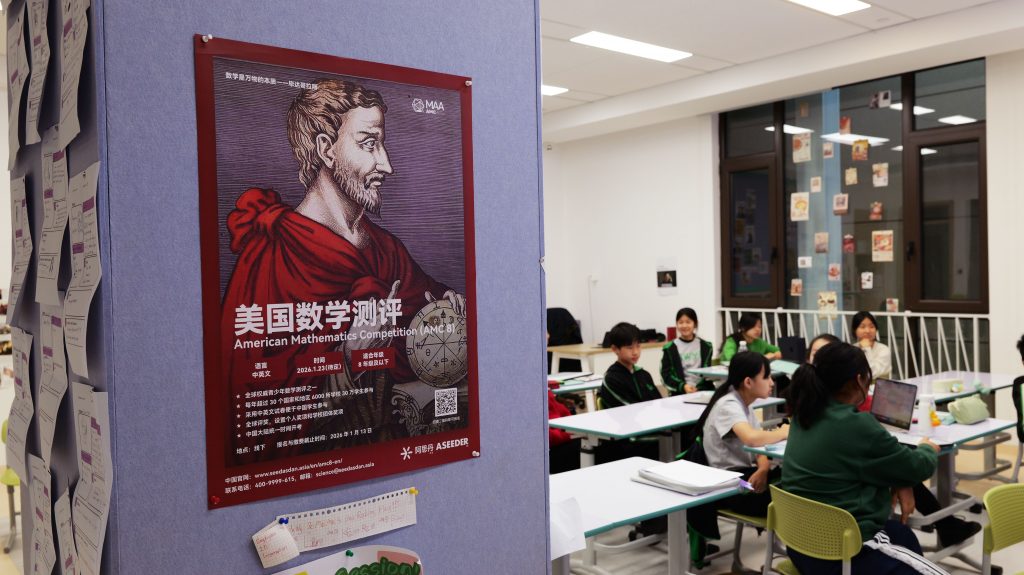
The lesson used American Mathematics Competitions (AMC) questions precisely because there is no textbook or sample problems where students can look at a similar example and simply copy the procedures to a related problem. Instead, students were expected to use their knowledge to solve something entirely new by developing solutions that no one had seen before.
This approach aligns with MYP objectives. It reinforces core Grade 7 concepts—fractions, ratios, algebraic reasoning—while pushing students beyond routine tasks into higher-order thinking. It also presents challenges for further learning, encouraging creativity and critical thinking in ways that standard exercises cannot.
The Lesson in Action
Group work and peer presentations were central to the experience. This structure not only models how mathematicians work in real life, but also mirrors how teams of researchers collaborate in industry to innovate and stay on the cutting edge of technology.
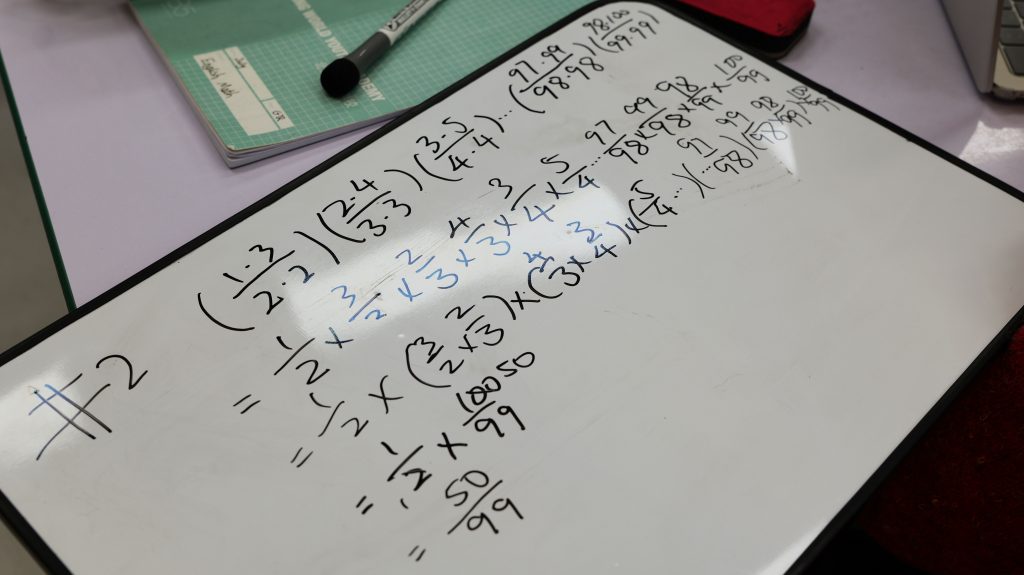
While working on the AMC questions, different groups developed their own unique approaches to solving the problems. The peer presentations allowed students to see multiple strategies for the same problem and fostered discussion about which approach was the most optimal.
Students needed to collaborate to overcome challenges too difficult to tackle alone. They learned from observing other teams and compared strategies to determine which solutions were the most elegant. The teacher noted being surprised by the types of solutions students created and how they differed from his own. There was no single correct way to solve the problems, but some solutions sparked richer discussions than others.
ATL Skills at the Core
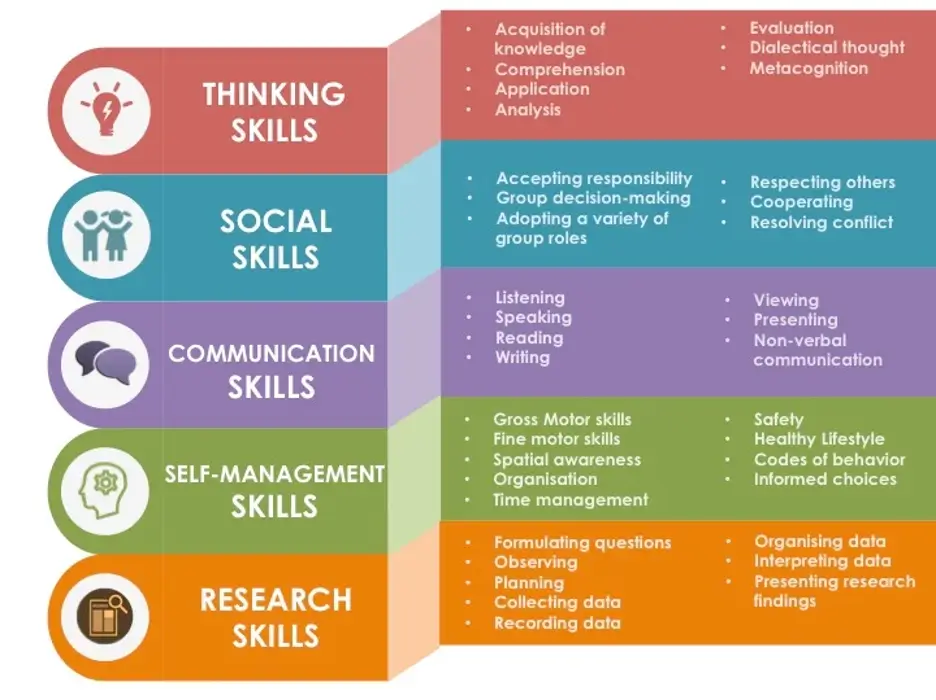
This lesson exemplifies two key Approaches to Learning (ATL) skills:
Critical Thinking: Students analysed complex problems, tested hypotheses, and refined strategies under time pressure.
Communication: They translated abstract reasoning into clear, structured explanations—using diagrams, precise language, and confident delivery.
These skills are essential for success in the IB Middle Years Programme and beyond. They empower students to become not only problem-solvers but also effective communicators, capable of sharing ideas in academic, professional, and global contexts.
Teacher’s Perspective
“We often ask students to find the answer. Today, we asked them to be mathematicians: to collaborate like a global research team and to communicate with the passion of someone sharing a breakthrough. The real victory wasn’t just a solution—it was the confidence to teach it.”
— Mr. Watson, Mathematics Teacher
Why It Matters
An IB education is holistic. It values cognitive development alongside social and emotional growth. By focusing on communication and critical thinking, this lesson nurtures attributes from the IB Learner Profile—students become thinkers, communicators, and risk-takers, ready to engage with challenging ideas and share their insights with the world.